FiveM Crafting and Production Chains: Designing Recipes Players Actually Want to Grind
A FiveM crafting system lives or dies on one question: does the player feel like they built something, or did they just watch a progress bar? Most crafting on roleplay servers fails the second test. You stand at a bench, click an item, wait, and a thing appears in your inventory. There’s no decision, no sourcing, no risk — and so there’s no reason to do it twice. The fix isn’t a fancier UI. It’s designing the recipe and the supply chain so that crafting is an activity, not a vending machine.
Recommended FiveM scripts for your server

![FREE Advanced Coke Job [Player Owned]](https://scripts-tebex.io/wp-content/uploads/b109ed84d447b3e72ce4c6ccfd67216392f4458b-300x169.avif)

Recipe Tiers Are What Give Crafting a Ceiling
Flat recipe lists go stale fast. A tiered structure — basic, intermediate, advanced — gives players something to climb toward and gives you a natural place to gate the powerful outputs. Tier one should be craftable with materials a new player can gather in their first hour. Tier three should require a refined intermediate that tier one feeds into, plus a rarer ingredient that isn’t trivially farmable.
The trap here is making higher tiers only harder, not more interesting. A tier-three weapon attachment that needs ten of the same screw you crafted at tier one is just a longer click. Each tier should introduce a new ingredient type or a new step, so the recipe reads differently as you go up.
The Sourcing Chain: Gather, Refine, Craft
The single biggest upgrade you can make to crafting is separating where ingredients come from, where they get processed, and where the final item is assembled. A real production chain looks like this:
- Gather — mine ore, scavenge components, harvest a plant. This is the activity that pulls players into the world and to specific map locations.
- Refine — turn ore into ingots, raw fiber into cloth, scrap into usable parts. This usually needs a different prop or location than gathering.
- Craft — combine refined materials at a bench into the finished good.
An ore → ingot → part → weapon chain means the final item carries the cost of three separate activities. That’s what makes a crafted item feel earned, and it’s what makes a crafted item worth real money on the player market. It also spreads players across the map instead of clustering them at one bench, which is good for emergent roleplay.
Benches, Props, and Place
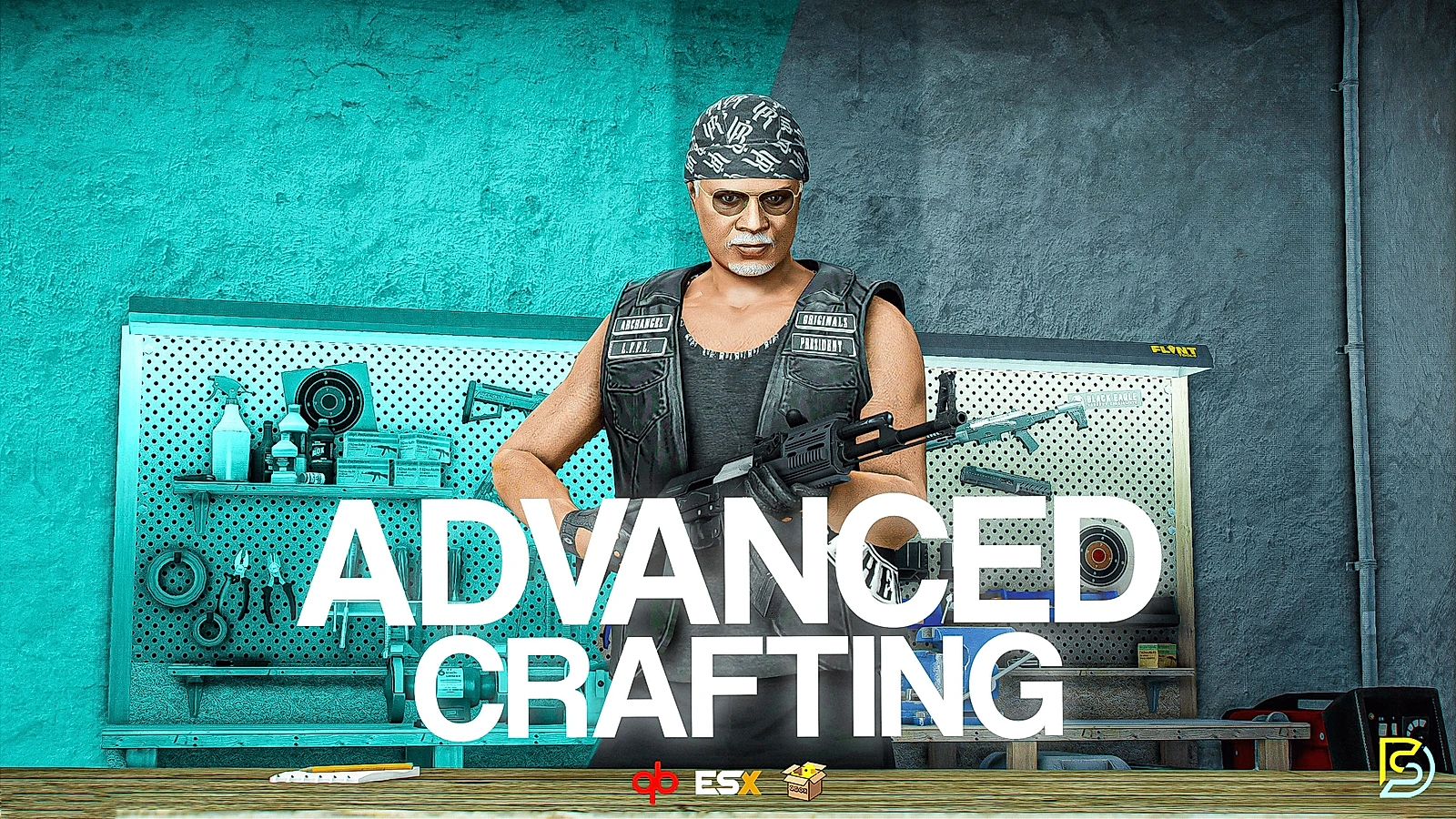
Crafting should be anchored to physical locations. A bench prop with a qtarget or ox_target zone, a placeable workbench item, or a fixed refinery — the point is that the player has to go somewhere. Locking certain recipes to certain benches (you can only smelt at the foundry, only assemble weapons at the gunsmith) turns crafting into a logistics decision and creates territory worth fighting over or controlling as a gang.
If your framework supports it, let players place their own crafting stations. A craftable bench that someone has to defend or hide changes the whole risk profile of a production operation.
Timers, XP Gating, and the “Click and Wait” Trap
Craft timers exist to stop instant mass-production from flooding the economy. Used badly, they create exactly the dead time players hate. The rule of thumb: a timer should be short for low-value items and long for high-value ones, and the player should never be staring at a bar with nothing to do. Better patterns:
- Queue-based crafting — start a batch, walk away, collect later. The wait happens while the player does something else.
- Skill/XP gating instead of pure time gating. Tie unlock of advanced recipes to a crafting skill that levels through use. A new player can’t make the good stuff yet, which protects value without making everyone wait.
- Success chance and quality rolls that improve with skill, so repeated crafting has a reason beyond raw output.
If you must use a long progress bar, give it a minigame or a reason to stay present — even a simple skill check beats ten minutes of nothing.
Durability and Item Sinks
Crafting only holds value if crafted items leave the economy. Without sinks, every server eventually drowns in legendary gear because supply only ever goes up. Build in:
- Durability on tools and weapons so they wear out and need recrafting or repair.
- Consumables — ammo, medical items, food — that get used up and keep demand steady.
- Repair recipes that themselves cost refined materials, so even maintenance feeds the chain.
A durability system is the difference between crafting being a one-time chore and an ongoing economic loop.
Balancing Crafting Against the Wider Economy
The mistake that quietly ruins crafting is pricing the inputs and outputs in a vacuum. If a crafted item sells to an NPC for more than the gathered materials are worth, you’ve created an infinite money printer and players will grind it to death. Always check the net: cost of materials plus time spent versus the item’s market value. Crafted goods should be worth more sold to other players than dumped on an NPC vendor — that’s how you push crafting toward the player economy instead of a payout exploit.
Whatever framework you’re on, test the full loop on a dev server with resmon open. A crafting menu that triggers a heavy inventory refresh or a per-tick distance check on every bench will tank your server’s frame time long before the economy ever becomes a problem. Profile the open/close and the craft action specifically.
Where to Find Crafting Resources and Further Reading
If you’re building this out, plenty of the heavy lifting is already done by existing scripts. For QBCore-specific crafting and skill systems that hook cleanly into qb-inventory and qb-skills, QBCore crafting scripts are the place to start. For a broader catalog spanning ESX and QBCore — benches, refineries, and full gather-to-craft chains — general FiveM crafting scripts covers most frameworks. And if you want to compare options across multiple vendors and find specialized production-chain resources, the FiveM script marketplace is worth a browse before you commit to a single system.
Get the sourcing chain and the sinks right and crafting stops being a side feature you bolted on. It becomes the backbone of your economy — the thing that gives mining, scavenging, and every job downstream a reason to exist.
![[QB] Weed Run for qb-core framework FiveM](https://scripts-tebex.io/wp-content/uploads/36f5f5c56358dea5fd704a2ad15ef2130f1e7b45-300x169.avif)